
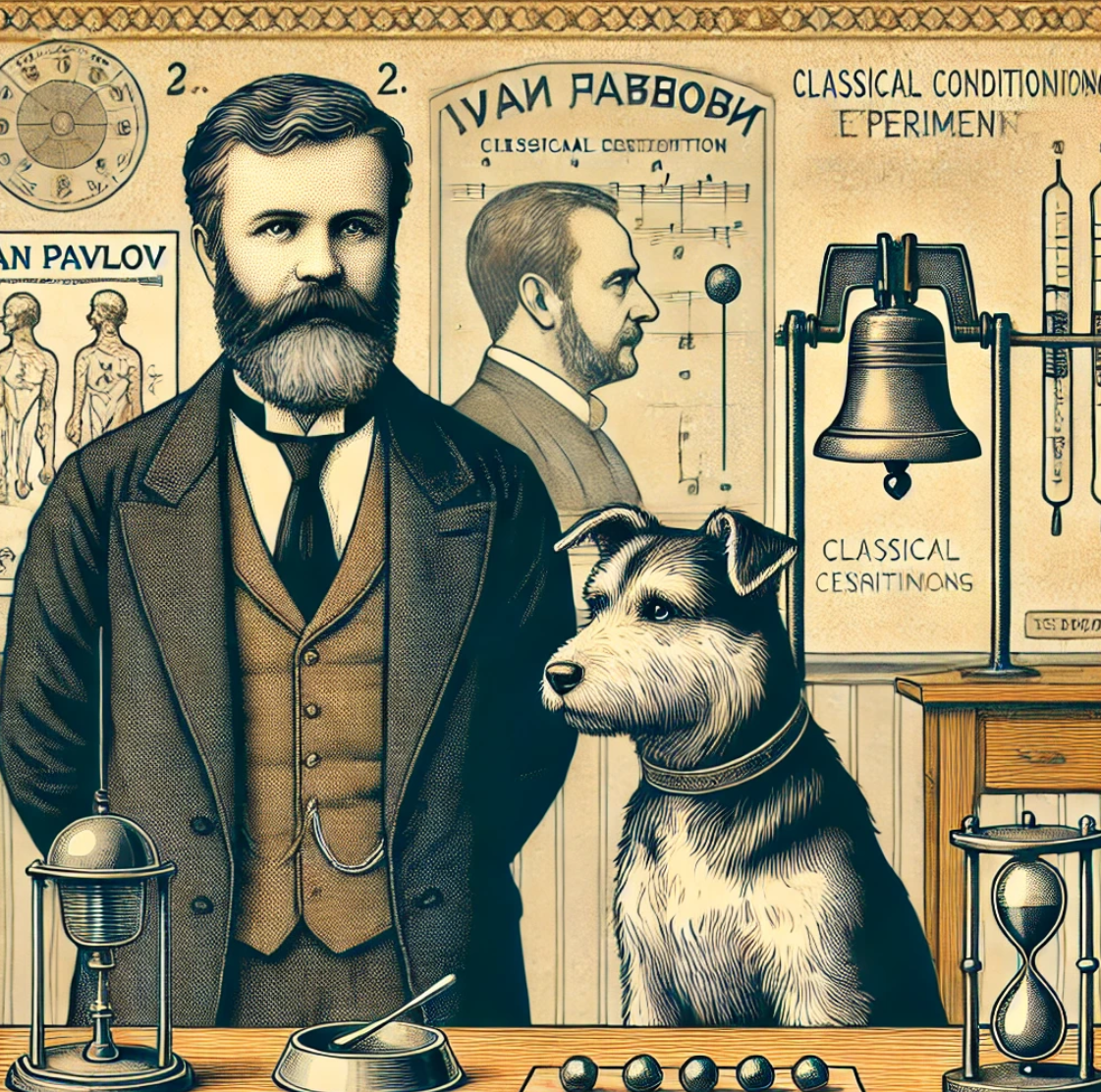
In the annals of psychological science, few tales are as captivating as that of Ivan Pavlov and his groundbreaking exploration of classical conditioning. At the heart of this scientific revelation were not just laboratory apparatus and meticulous observations, but a group of astute dogs whose natural behaviours illuminated the pathways of associative learning.
A Serendipitous Discovery

Ivan Pavlov’s dog study of digestion, embarked on experiments to understand the intricacies of salivary responses to food. His method involved presenting dogs with meat powder and measuring their salivation—a straightforward endeavor aimed at unraveling digestive mechanisms. However, the narrative took an intriguing turn when Pavlov noticed that the dogs began to salivate merely at the sight of the lab assistant who fed them, even before any food was presented. This unexpected observation hinted at a deeper, learned association forming in the dogs’ minds.
Decoding the Learning Process
Intrigued by these anticipatory salivations, Pavlov devised a series of experiments to delve into the phenomenon. He introduced a neutral stimulus—a metronome’s ticking—prior to presenting the meat powder. Initially, the metronome’s sound elicited no particular response from the dogs. Yet, after several pairings of the metronome’s ticking followed by the food, the dogs began to salivate solely in response to the metronome, even in the absence of food. This pivotal finding demonstrated that the dogs had learned to associate a previously neutral stimulus with a significant event, leading to a conditioned response.
The Canine Cognition at Play
These experiments underscore the remarkable cognitive abilities of dogs. Their capacity to detect patterns and form associations speaks volumes about their intelligence and adaptability. Pavlov’s dog subjects weren’t merely passive participants; they were active learners, showcasing the sophisticated ways in which animals interpret and respond to their environments.
Fundamental Elements of Classical Conditioning
Pavlov’s work delineated several core components of classical conditioning:
- Unconditioned Stimulus (US): A stimulus that naturally and automatically triggers a response without prior learning. In this context, the meat powder served as the unconditioned stimulus.
- Unconditioned Response (UR): The unlearned, natural reaction to the unconditioned stimulus, such as the dogs’ salivation in response to the meat powder.
- Conditioned Stimulus (CS): An initially neutral stimulus that, after being paired with the unconditioned stimulus, comes to elicit a conditioned response. The metronome’s ticking became the conditioned stimulus.
- Conditioned Response (CR): The learned response to the previously neutral stimulus, exemplified by the dogs’ salivation solely in response to the metronome after conditioning.
Beyond the Laboratory: Real-World Implications

The principles unearthed through Pavlov’s research extend far beyond the confines of his laboratory. Classical conditioning permeates various facets of daily life and has been instrumental in developing therapeutic interventions. For instance, understanding how associations form has led to effective treatments for phobias and anxiety disorders, where neutral stimuli become linked to fear responses. By systematically desensitizing individuals to these stimuli, therapists can help decouple the conditioned associations, alleviating distress.
Enhancing Canine Training

Pavlov’s insights have profoundly influenced dog training methodologies. Trainers harness the power of classical conditioning to reinforce desirable behaviours and discourage unwanted ones. By consistently pairing commands with rewards, dogs learn to associate specific cues with positive outcomes, facilitating effective and humane training practices. This approach not only fosters obedience but also strengthens the bond between dogs and their owners, rooted in mutual understanding and communication.
The Enduring Legacy
The legacy of Ivan Pavlov’s dog collaborators endures in the realms of psychology, neuroscience, and education. Their collective contribution has provided a foundational understanding of associative learning, influencing countless studies and applications. The story of Pavlov’s dogs serves as a testament to the profound insights that can emerge from observing and interpreting animal behavior, highlighting the intricate connections between stimuli and responses that shape learning processes.
Last Bark
Ivan Pavlov’s exploration into classical conditioning, illuminated by the intelligent responses of his canine subjects, has left an indelible mark on our comprehension of learning and behavior. The dogs’ ability to form associations and anticipate outcomes underscores their cognitive prowess and offers valuable lessons in both human and animal psychology. As we continue to delve into the complexities of learning, the pioneering work of Pavlov and his perceptive dogs remains a beacon, guiding our understanding of the nuanced dance between stimuli and responses that defines the learning experience.
For a visual depiction of Pavlov’s experiments and the concept of classical conditioning, you might find the following resource insightful:
Frequently Asked Questions
Here are some common questions customers may have about this topic.
What was the original purpose of Ivan Pavlov’s experiments with dogs?
Pavlov initially aimed to study the digestive process by measuring dogs’ salivation in response to meat powder. His goal was to understand physiological responses related to digestion, not to investigate learning or behaviour initially.
How did Pavlov discover the concept of classical conditioning?
Pavlov noticed that dogs began salivating merely at the sight of the lab assistant before any food was presented. This observation led him to explore how a neutral stimulus, like a metronome, could be associated with food to trigger salivation, revealing the learning process now called classical conditioning.
What roles do the unconditioned stimulus and conditioned stimulus play in Pavlov’s experiment?
The unconditioned stimulus (US) naturally triggers a response, here the meat powder causing salivation. The conditioned stimulus (CS) is initially neutral, like the metronome, but after pairing it with the US, it elicits a learned response, demonstrating how associations form in classical conditioning.
Why are Pavlov’s dogs considered active learners rather than passive subjects?
The dogs demonstrated cognitive abilities by detecting patterns and forming associations between stimuli and outcomes. Their anticipatory salivation to the metronome shows that they actively interpreted environmental cues rather than merely reacting automatically.
How does Pavlov’s research with dogs contribute to our understanding of animal cognition?
Pavlov’s experiments highlight dogs’ capabilities to learn through association, illustrating sophisticated mental processing. This work provides foundational insight into how animals adapt behaviour based on experience, influencing both psychology and animal training methods.