

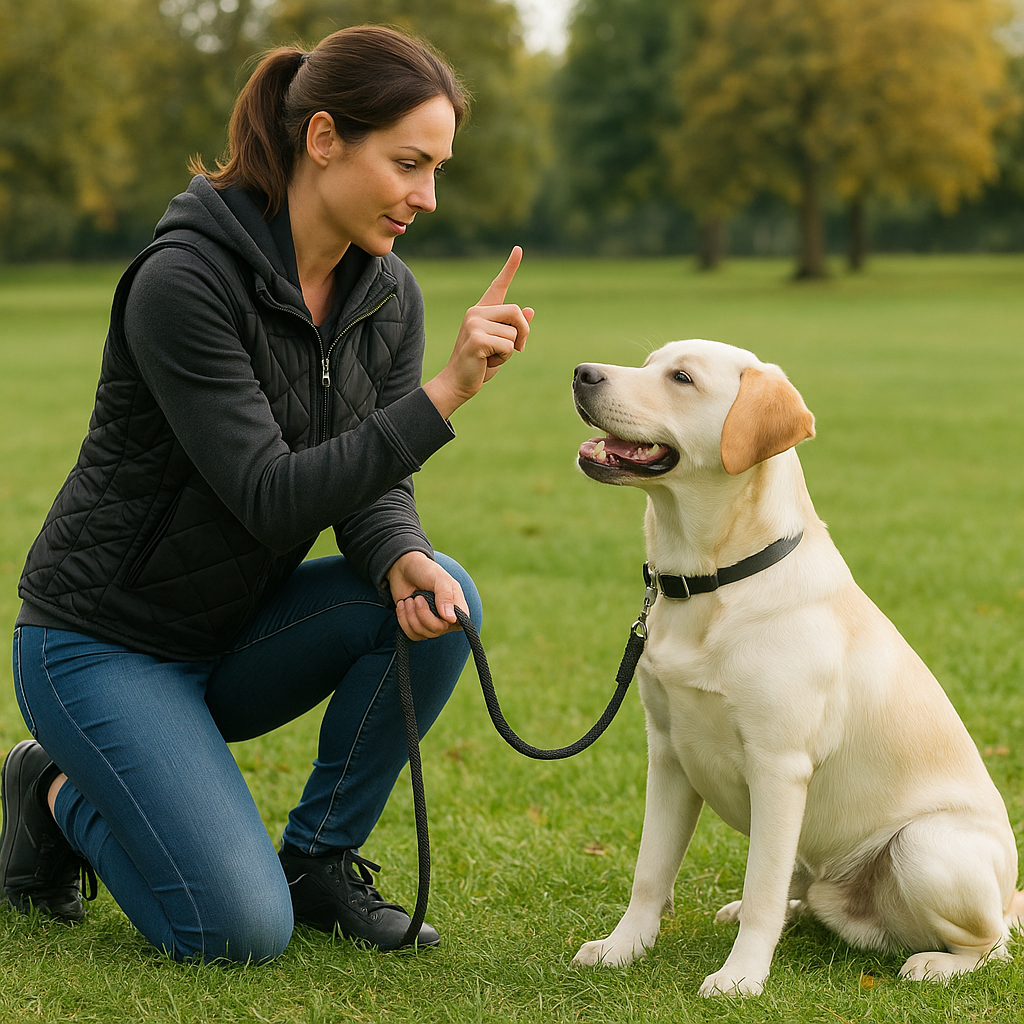
Not all dog training approaches are equal, and not all of them suit every dog. What works well for a confident, food-motivated Labrador may do very little for an anxious rescue or a stubborn terrier. Understanding the main methods gives you a better basis for choosing what to try — or for evaluating the approach a professional trainer is using with your dog.
These are the ten methods most commonly used or discussed by professional trainers in the UK, along with an honest assessment of each.
1. Positive Reinforcement
Positive reinforcement is the method most widely recommended by UK training organisations, including the RSPCA and Dogs Trust. The principle is simple: when your dog does something you want them to repeat, you reward them immediately. The reward can be food, a toy, praise, or anything the dog finds motivating.
The reason it works well isn’t magic — it’s conditioning. Dogs repeat behaviours that produce good outcomes. The key variables are timing (the reward needs to come within a second or two of the behaviour) and consistency (rewarding the same behaviour every time during the learning phase). Where it goes wrong at home is usually one of those two things.
Worth noting: positive reinforcement doesn’t mean permissive. You can train firm boundaries entirely through reward-based methods. The absence of punishment doesn’t mean the absence of expectations.
2. Clicker Training
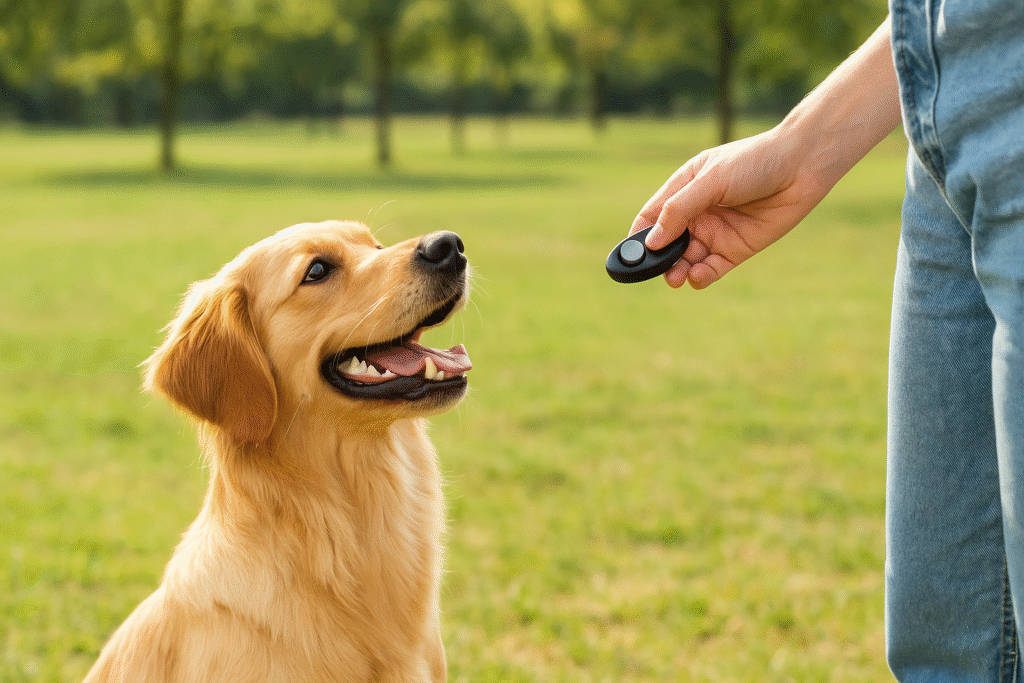
Clicker training is a specific application of positive reinforcement that uses a small handheld device to mark the exact moment a dog does something right. The click happens at the precise instant of the correct behaviour — before the treat arrives — so the dog learns to associate that sound with “that thing you just did.”
The advantage over using your voice alone is consistency. A clicker always sounds the same. Your voice changes depending on whether you’re pleased, distracted, or slightly irritated, and dogs pick up on those variations in ways that can muddy the signal. For teaching precise behaviours — a clean sit, the exact moment of eye contact during a recall — a clicker gives you a level of accuracy that’s hard to replicate otherwise.
You can find a great dog training clicker at Calmshops if you want to give it a try. Pair it with small, high-value treats and start with something simple your dog already knows.
3. Obedience Training

Obedience training is the foundation rather than a method in isolation — it’s the practical application of whatever technique you’re using to teach specific commands. Sit, stay, down, heel, come. These aren’t arbitrary behaviours; they’re the commands that keep a dog safe in real-world situations.
The UK approach, particularly through Kennel Club Good Citizen schemes and puppy classes run by APDT or IMDT members, tends to start early and keep sessions short. Puppies have limited attention spans and fatigue quickly — five minutes done well beats twenty minutes of diminishing returns. The goal isn’t just compliance; it’s a dog that responds reliably in environments with distractions, not just in the quiet of your living room.
If you’re struggling with a specific behaviour, check our post on the most common mistakes made during dog training before assuming the method isn’t working.
4. Science-Based Training
Science-based training isn’t a single technique — it’s an approach that grounds training decisions in evidence from animal behaviour research rather than tradition or anecdote. A science-based trainer will ask what the evidence says about reinforcement schedules, timing, generalisation, and the effects of punishment before choosing how to address a behaviour.
In practice, this tends to mean a commitment to positive reinforcement as the primary tool, an understanding of why certain punitive methods can backfire, and a willingness to adapt when something isn’t working rather than repeating it harder. It’s the approach taken by most IMDT and APDT members in the UK.
The practical implication for dog owners: if a trainer can’t explain why they’re using a particular technique, or falls back on “it’s what I’ve always done,” that’s worth questioning.
5. Model-Rival (Mirror) Training
Model-rival training uses social learning — dogs observing and imitating others. In a training context, a well-trained dog or another person demonstrates the target behaviour, giving the learner a model to copy.
It’s most often seen in group training classes, where watching other dogs work can prompt a reluctant dog to engage. It also happens informally in multi-dog households, where a newer dog picks up habits — good and bad — from an established one.
The limitation is that dogs don’t generalise from observation as readily as humans do. Watching another dog sit on command doesn’t automatically teach your dog what “sit” means. Model-rival works best as a supplement to direct training rather than a replacement for it.
6. Relationship-Based Training

Relationship-based training puts the bond between dog and owner at the centre of the process. Before asking why a dog won’t comply with a command, it asks what the dog’s motivational state is, whether the communication between dog and owner is clear, and whether the training environment is working for or against learning.
This is particularly valuable with rescue dogs or dogs that have had negative experiences with training. A dog that’s anxious or doesn’t trust its owner yet isn’t in a state where it can learn efficiently. Building the relationship first — through consistent, low-pressure interactions — creates the conditions in which training becomes possible.
It’s a slower approach than straight obedience work, but the results tend to be more durable because the dog is actively engaged rather than just compliant.
7. Humane Tools Alongside Training
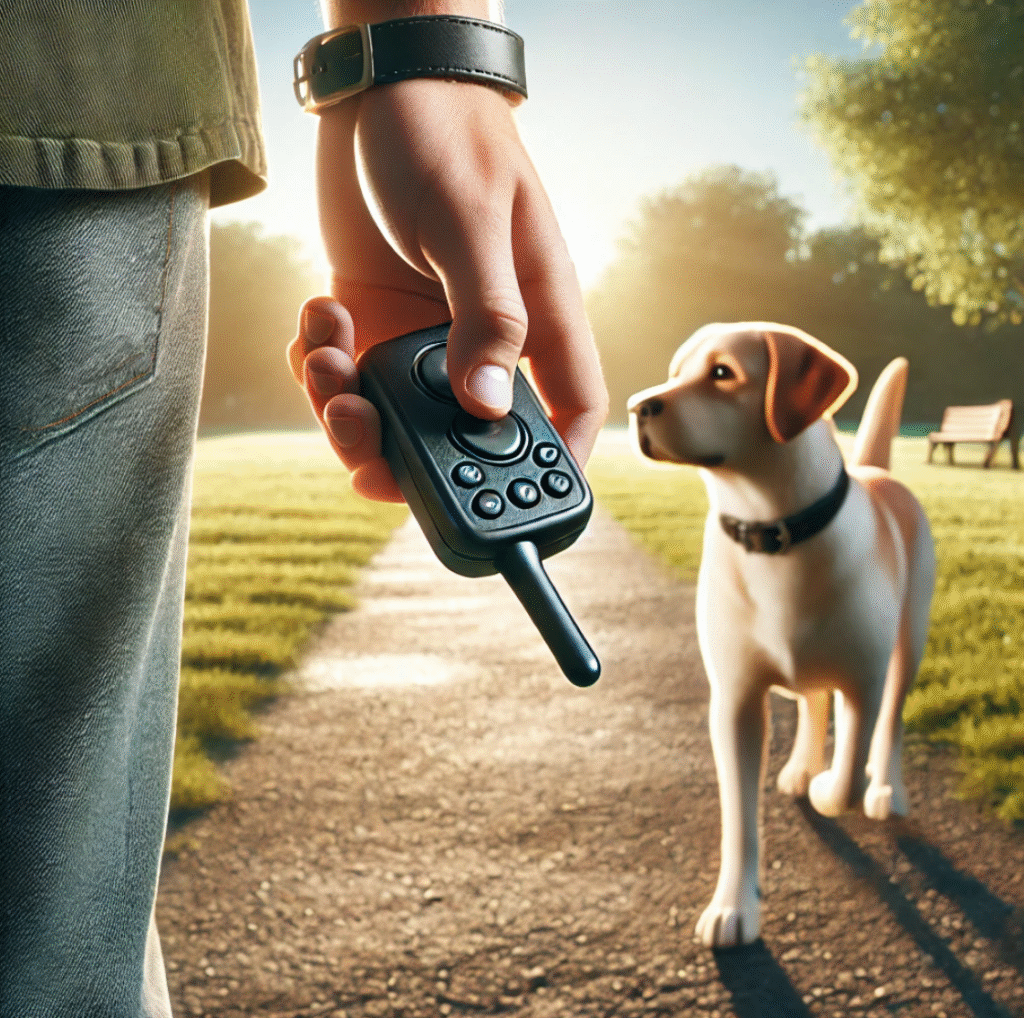
In the UK, electric shock collars are banned in Wales and were subject to proposed bans in England, reflecting a broad professional consensus that aversive tools cause more problems than they solve. Most UK professional trainers work entirely without them.
That doesn’t mean no tools are used. Vibrating collars and citronella spray collars are legitimate alternatives used by professionals to provide a clear, non-painful signal at a distance — particularly useful for recall training where your voice can’t carry. At Calmshops, our no-shock training collars are designed to be used as communication tools alongside positive reinforcement, not as corrections in isolation.
The distinction matters: a tool that interrupts a behaviour and allows you to redirect to something rewardable is very different from one used to punish after the fact.
8. Operant Conditioning
Operant conditioning is the theoretical framework underpinning most modern dog training, whether trainers explicitly name it or not. B.F. Skinner identified four ways that consequences shape behaviour:
Positive reinforcement — adding something good (a treat) to increase a behaviour. Negative reinforcement — removing something unpleasant to increase a behaviour (releasing lead pressure when a dog stops pulling). Positive punishment — adding something unpleasant to decrease a behaviour. Negative punishment — removing something good to decrease a behaviour (turning away when a dog jumps up).
UK professional training leans heavily on positive reinforcement and negative punishment while largely avoiding positive punishment — not for ideological reasons, but because the evidence suggests it produces worse outcomes: slower learning, increased anxiety, and a higher risk of aggression.
Understanding these four quadrants helps you evaluate training advice you encounter, because most of it fits into one of these categories whether the person giving it knows that or not.
9. Dominance Theory (Largely Outdated)
Dominance theory — the idea that dogs misbehave because they’re trying to be “alpha” and that owners need to establish themselves as pack leader — was widely promoted in the 1970s and 1980s and shaped a generation of dog training advice. Much of it is still circulating online and in older books.
The problems with it are well documented. The original wolf pack studies that inspired it were conducted on captive wolves with no natural social bonds — not an accurate model for domestic dogs or wild wolf behaviour. More importantly, training methods derived from dominance theory (alpha rolls, scruff shakes, confrontational face-offs) can trigger fear and defensive aggression in dogs, making problems worse rather than better.
Most UK professional organisations have explicitly moved away from dominance-based approaches. If you encounter advice based on “showing the dog who’s boss,” it’s worth treating it sceptically regardless of how confidently it’s delivered.
10. Agility & Activity-Based Training
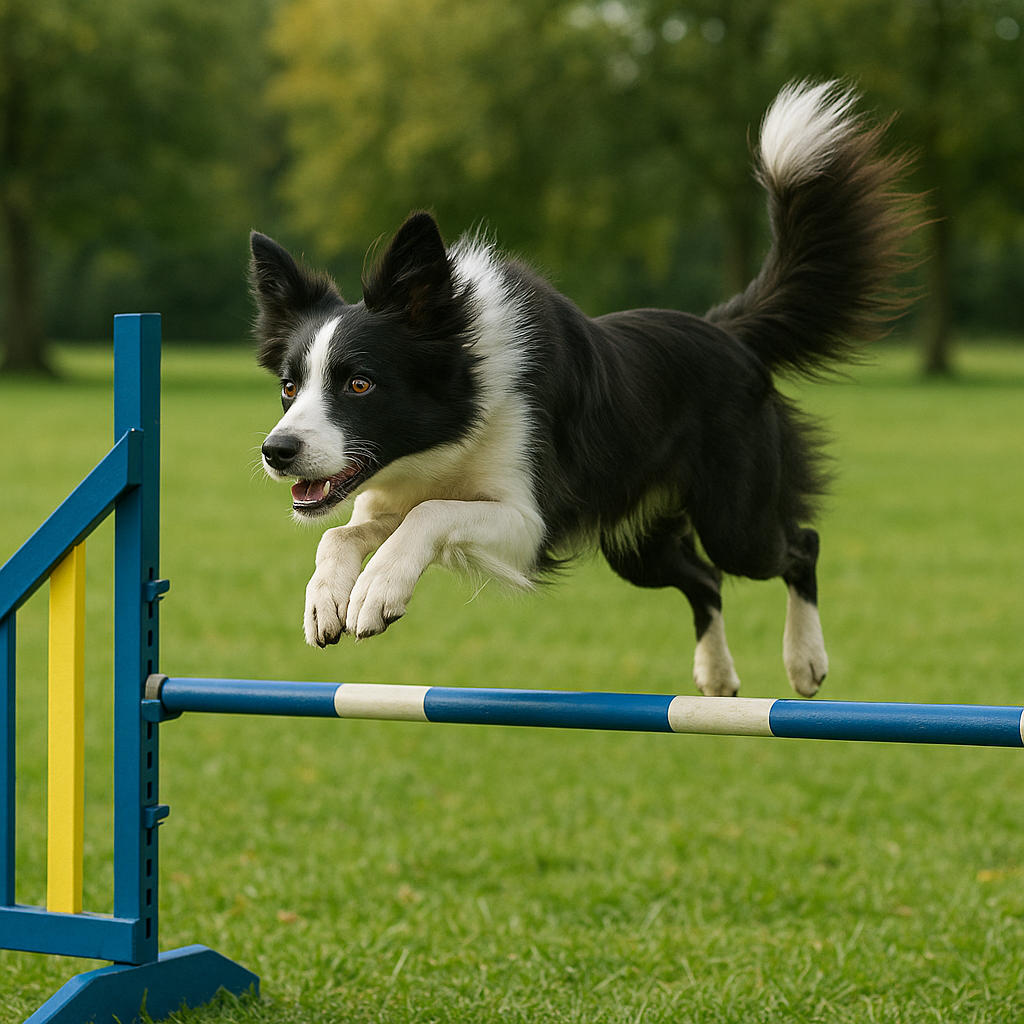
Agility training uses obstacle courses — jumps, tunnels, weave poles, contact equipment — to develop a dog’s coordination, focus, and responsiveness to handler cues. It’s both a competitive sport and a training tool used by professionals to build skills that transfer to everyday behaviour.
The benefits extend beyond the physical. A dog working an agility course has to maintain focus on its handler while processing a lot of environmental information — exactly the cognitive demand that makes obedience in distracting real-world environments difficult. Dogs that train regularly in agility often show noticeably improved responsiveness in other contexts.
Many UK clubs run beginner agility classes that are as useful for socialisation and mental stimulation as they are for developing the sport-specific skills. If your dog is high-energy and struggles to settle, it’s worth trying before assuming you have a behaviour problem.
Which method should you use?
Realistically, most professional trainers use several of these methods simultaneously rather than picking one and sticking to it. A typical session might combine positive reinforcement as the core approach, a clicker for precision marking, relationship-based principles to read the dog’s emotional state, and operant conditioning theory to understand why something is or isn’t working.
The starting point for most dogs and most owners is positive reinforcement with clear, consistent timing. From there, you adapt based on what your specific dog responds to. If you’re not making progress after a reasonable effort, that’s when a professional trainer can help identify what needs to change — whether it’s your technique, the training environment, or something about how the behaviour was originally learned.
Frequently Asked Questions
Here are some common questions dog owners may have about this topic.
What makes positive reinforcement effective?
It works because dogs repeat behaviours that produce good outcomes. The key is timing — the reward needs to come within a second or two of the correct behaviour — and consistency during the learning phase. It also makes training something the dog actively participates in rather than endures.
How does clicker training differ from voice-based methods?
A clicker produces exactly the same sound every time, whereas your voice changes with mood, intonation, and context. For marking precise behaviours — the exact moment of eye contact, the instant all four paws are on the ground — that consistency makes a meaningful difference.
Why is obedience training important?
The commands it teaches — sit, stay, recall, heel — are the ones that keep a dog safe in real-world situations. A dog that responds reliably in a quiet garden but ignores you on a busy street hasn’t fully learned the behaviour. Obedience training done properly means the dog responds under distraction.
What’s wrong with dominance-based training?
The original research it was based on was conducted on captive wolves in unnatural conditions — not an accurate model for domestic dogs. Methods derived from it can trigger fear and defensive aggression. Most UK professional organisations have moved away from it because the evidence doesn’t support it and because the risks are real.
How do I choose between training methods?
Start with positive reinforcement and consistent timing — this works for the majority of dogs and owners as a foundation. If you’re not making progress, consult a professional trainer who can assess your specific situation rather than switching randomly between approaches.