

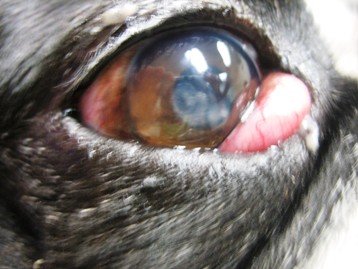
Cherry eye is a prolapsed gland of the third eyelid: the tear gland pops out of place and shows as a red swelling in the corner of the eye. The PDSA says it usually develops before a dog is a year old and can affect one or both eyes. Speak to your vet rather than waiting to see if it settles.
At a glance
- What it is: the gland inside the third eyelid prolapses (pops out), forming a red lump in the eye corner.
- Who it affects: mostly young dogs, and some breeds far more than others.
- Urgency: soon. The PDSA says to contact a vet as soon as possible.
- Vet needed? Yes. Repair is a vet’s job, and often a surgical one.
Signs to look for
The PDSA describes a red swelling in the corner of the eye. It can happen in one eye or both, and a dog that has it in one eye may go on to develop it in the other. The Royal Veterinary College (RVC) also lists more watery discharge, squinting or frequent blinking, and pawing or rubbing at the eye.
Causes and risk factors
Dogs have a third eyelid, which helps protect the eye and spread tears. The RVC says the gland inside it produces up to 30 per cent of the watery layer of the tear film, which is why it matters for long-term eye health.
The exact cause is not known. The PDSA says cherry eye tends to run in families, and Blue Cross says affected dogs normally have a genetic predisposition. A 2025 genetics paper in Frontiers in Veterinary Science likewise points to loose connective tissue holding the gland, usually on a genetic basis, though its own study was small (12 affected dogs) and the authors say the cause is currently unknown.
Any breed can be affected. The PDSA names French Bulldogs, Pugs, Great Danes and Beagles as especially common. RVC research puts cherry eye at about 1 in 500 dogs and found the highest risk in Neapolitan Mastiffs, English Bulldogs and Lhasa Apsos. The Frontiers paper says it is more common in flat-faced (brachycephalic) dogs, with onset typically between 3 and 12 months. If you share your life with a flat-faced breed, our guide to BOAS in dogs covers the other health quirks of that shape.
When to call your vet
Contact your vet as soon as you notice it. The PDSA is firm that you shouldn’t wait to see whether it improves. While you wait for treatment, it says a buster (cone) collar can stop your dog rubbing the eye, so speak to your vet about whether to use one.
The RVC says untreated cherry eye can lead to painful conjunctivitis, infection, chronic dry eye and corneal ulcers. Our vets guide can help you find a practice if you don’t have one, and our sick dog symptoms page helps if other signs are showing too.
How vets diagnose it
The PDSA calls cherry eye often very easy to spot, because of the typical swelling. Your vet will look at the eye and decide on the best approach. The PDSA adds that, because affected dogs are at higher risk of dry eye, vets may check tear production from time to time.
What vets generally do about it
Treatment is decided by your vet. The RVC calls surgery the only treatment and recommends repairing the gland rather than removing it, and Blue Cross says removal can cause dry eye. The PDSA explains that surgery now usually means sewing the gland back into a pocket inside the third eyelid. Difficult cases may need a specialist eye hospital.
Vets may also prescribe false tears, anti-inflammatory drops or antibiotic drops if there is an infection, plus pain relief around the operation. The gland can pop out again, and the PDSA says more than one operation may sometimes be needed. The RVC puts repeat prolapse at about 5 to 10 per cent of cases and lists other risks, including anaesthesia, wound problems and a small chance of a corneal ulcer. Most cases can be put right, the PDSA says.
Living with it and prevention
After surgery, follow your vet’s instructions closely. The PDSA says to keep the buster collar on until the vet says it can come off, to avoid running, jumping and playing, and to use a harness rather than a neck collar during recovery, because pressure on the neck can raise pressure in the eye.
The PDSA says treatment for cherry eye can become very expensive, and more than one operation is sometimes needed, so see our pet insurance guide. There is no known way to prevent it, but the PDSA strongly discourages breeding from affected dogs, even if the condition was corrected.
Related conditions
- Dry eye in dogs, a possible complication
- Conjunctivitis in dogs, another cause of a red, sore-looking eye
- BOAS in dogs, common in the same flat-faced breeds
- Cataracts in dogs
- Glaucoma in dogs
- Browse the full A-Z of dog illnesses and conditions
Sources
- PDSA, Cherry eye in dogs
- Royal Veterinary College, Cherry eye surgery
- Blue Cross, Cherry eye in dogs
- Frontiers in Veterinary Science, Genome-wide association studies with prolapsed gland of the third eyelid in dogs
Frequently Asked Questions
Will cherry eye go away on its own?
The PDSA advises contacting a vet as soon as possible rather than waiting to see if it improves. Blue Cross says surgery is normally needed. Speak to your vet.
Why do vets not just remove the gland?
The PDSA says removal is no longer standard because it can cause dry eye. The gland is usually sewn back into a pocket inside the third eyelid instead. Your vet will decide the right operation.
Can cherry eye come back after surgery?
Yes, it can. The PDSA says the gland can pop out again and more than one operation may be needed, and a dog treated in one eye may develop it in the other. Speak to your vet about what to watch for.
Which dog breeds get cherry eye?
Any breed can, but the PDSA says it is especially common in French Bulldogs, Pugs, Great Danes and Beagles. It usually develops before a dog is one year old.
This page is general information, not veterinary advice. If you are worried about your dog, speak to your vet. Written by Georgiana & Figo, who are dog owners, not vets. Have a look around Calmshops for everyday dog essentials.


