


Bringing a puppy home is one of the most exciting things you can do — and one of the most important decisions you’ll ever make. Get it right and you’ll have a loyal companion for 10 to 15 years. Get it wrong and you could end up heartbroken, out of pocket, and supporting an industry that causes real suffering to dogs.
This guide covers every legitimate route to finding a puppy in the UK, including the pros and cons of each option, what the law says, how rescue puppies work, and what to do before you even start looking.
We went through a breeder ourselves when we got Figo, and I remember the waiting and the endless questions feeling like they’d never end at the time. Looking back, every single one of those questions mattered, which is exactly why the checks and red flags below are worth taking seriously, whichever route you end up going down.
What the Law Says First
Before we get into where to look, it’s worth understanding the legal landscape, because it shapes everything.
Lucy’s Law came into force in England in April 2020 and bans the commercial third-party sale of puppies. This means pet shops and dealers can no longer sell puppies — you must buy directly from the breeder, or adopt from a rescue centre. Scotland and Wales have since introduced their own equivalent legislation. The aim was to eliminate puppy farms, which depend on middlemen to disguise the conditions animals are bred in.
In practice, this is genuinely good news for buyers. It means when you visit a puppy, you should be meeting the actual breeder and seeing the litter with their mother in the place they were born. If that isn’t happening, walk away — it’s a red flag and may well be illegal.
Licensed breeders in England must show puppies interacting with their mothers at their place of birth. Selling puppies without a licence can result in an unlimited fine or up to six months in prison.
Where to Find Puppies for Sale in the UK
1. The Kennel Club’s Find a Puppy Service

Website: royalkennelclub.com/search/find-a-puppy
The Kennel Club is the UK’s official registry for pedigree dogs, and their Find a Puppy service lists puppies from breeders who have agreed to their Assured Breeder Scheme standards.
Pros:
- Breeders must meet welfare standards and agree to health testing requirements
- Puppies are registered pedigrees, so you get full lineage documentation
- Good for finding specific, less common breeds
- Offers an Assured Breeder Scheme with additional checks
Cons:
- Only covers pedigree dogs (no crossbreeds or mixed breeds listed)
- The Kennel Club acknowledges it cannot individually vet every breeder on the platform
- Prices tend to be at the higher end
Best for: Anyone set on a specific pedigree breed and willing to wait for a reputable litter.
2. Pets4Homes
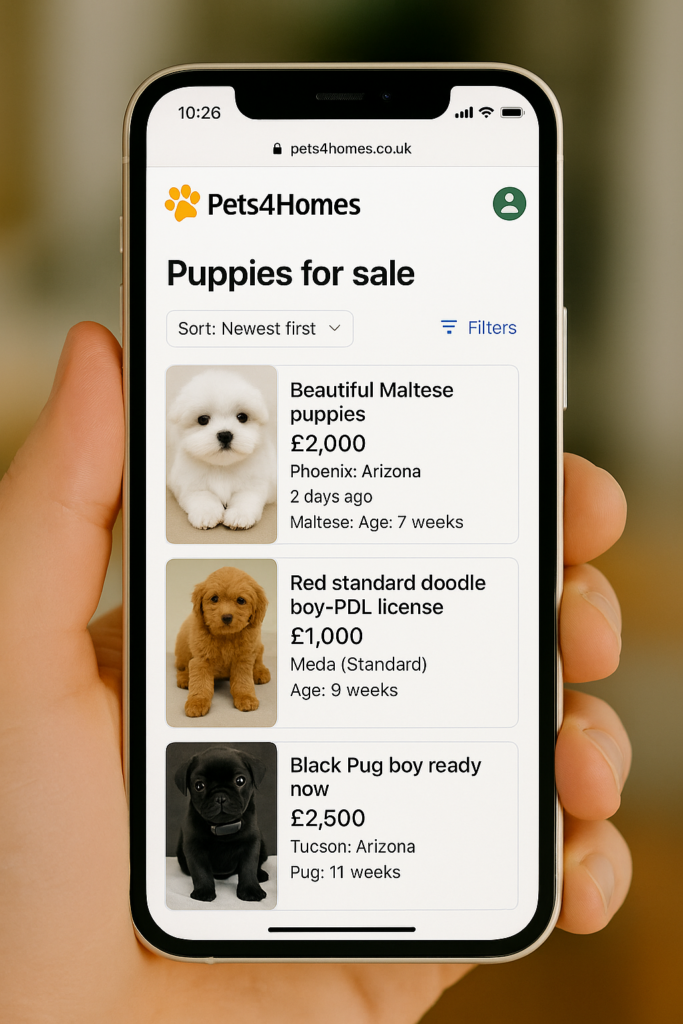
Website: pets4homes.co.uk
Pets4Homes is the UK’s largest pet classifieds site, with thousands of puppy listings at any given time. It operates as an open marketplace, but has implemented some verification features over the years.
Pros:
- Huge variety of breeds and crossbreeds
- Large selection means more choice of location and litter size
- Breeders can display verification badges and health test results
- Easy to filter by breed, location, and price
Cons:
- It’s a classifieds marketplace, so quality varies enormously between listings
- Despite some safeguards, not all breeders are rigorously screened
- Popular with both responsible breeders and those cutting corners. You need to do your own due diligence
- Some listings for deliberately bred “designer” crosses push prices to unrealistic levels
Best for: Buyers who know what to look for and are confident doing thorough checks themselves.
3. Puppies.co.uk
Website: puppies.co.uk
Puppies.co.uk takes a more curated approach than a standard classifieds site. They ID-verify all breeders and carry out manual checks on listings, reportedly rejecting around half of applicants. They claim to have matched over 220,000 puppies with families.
Pros:
- ID verification for all breeders
- Human review team checks listings before they go live
- Cleaner, less cluttered browsing experience than open marketplaces
- Deposit protection scheme via Trustap
Cons:
- Smaller pool of listings than Pets4Homes
- Verification doesn’t mean every breeder is exceptional — it’s a baseline, not a guarantee
- Newer platform, so less track record than the Kennel Club
Best for: Buyers who want more confidence in the platform without limiting themselves to pedigree-only listings.
4. UKPets
Website: ukpets.com
UKPets is another established classifieds-style platform with a reasonable range of breeds and crossbreeds. It includes breed information pages alongside listings, which is genuinely useful if you’re still deciding on a breed.
Pros:
- Good breed research tools on the site
- Reasonable range of listings across the UK
- Relatively straightforward to use
Cons:
- Less stringent breeder verification than Puppies.co.uk
- Quality of listings is inconsistent, so treat it like any classifieds site
Best for: Buyers who are still researching breeds and want to browse alongside reading up on different types of dog.
5. Gumtree
Website: gumtree.com
Let’s be honest: Gumtree is the wild west of puppy listings. It’s free to advertise, which means the barrier to entry is as low as it gets.
Pros:
- Lots of listings, often at lower prices
- Can sometimes find genuine breeders who prefer free advertising
Cons:
- Minimal vetting of sellers
- Higher risk of encountering scams, puppy farms operating illegally, or importation fraud
- “Too cheap to be true” listings are common here
- No meaningful accountability for sellers
Best for: We’d honestly steer most people away from Gumtree for puppies unless they have a very experienced eye. It’s not impossible to find a decent breeder here, but the due diligence required is significantly higher.
6. Freeads
Website: freeads.co.uk
Similar to Gumtree in that it’s a free-to-list classifieds platform. It calls itself an “ethical” site and has made efforts to improve standards, but the inherent limitations of a free marketplace still apply.
Pros:
- Free listings mean some genuine domestic breeders use it
- Decent number of listings across the UK
Cons:
- Same caveats as Gumtree — inconsistent quality and minimal vetting
- Prices here can be artificially low, which is not always a good sign
7. Direct from a Breeder (Recommended)
This is still the gold standard, and it’s the route we took with Figo. Whether you find them through a breed club, word of mouth, your vet, or a listing site, buying directly from a responsible small-scale breeder who raises litters in their home gives you the best start.
Signs of a good breeder:
- They ask you questions about your lifestyle, home, experience with dogs
- They let you visit more than once and meet the mother with the puppies
- They offer to take the puppy back if your circumstances change
- They provide a health contract, vaccination records, microchip details, and ideally breed-specific health test results
- They don’t have puppies available all year round
The wait for a well-bred puppy from a reputable breeder can be months. That wait is almost always worth it.
Red Flags to Watch Out For
Whatever platform you use, these signs should make you stop and reconsider:
- The seller won’t let you visit the puppy at home with its mother
- Puppies are described as “ready to go” before 8 weeks of age (it’s illegal to sell a puppy under 8 weeks in the UK)
- The seller offers to deliver the puppy to you or meet you in a car park
- There are no veterinary records, microchip documents, or vaccination history
- The price is suspiciously low for the breed
- Multiple breeds are available simultaneously
- The “breeder” can’t answer detailed questions about the parents or the litter
How to Get a Rescue Puppy in the UK
Buying from a breeder is one route — but it’s far from the only one. Rescue organisations across the UK regularly have puppies and young dogs looking for homes, and adopting rather than buying is something worth genuinely considering.
How rescue works: Most rescue centres will ask you to fill in an adoption application, answer questions about your home and lifestyle, and may carry out a home visit. This isn’t gatekeeping for the sake of it, but about matching dogs with the right environment. The process usually takes a few weeks.
Where to find rescue puppies in the UK:
- Local council-run kennels
- RSPCA and SSPCA centres
- Dogs Trust rehoming centres
- Battersea Dogs & Cats Home
- Many smaller independent rescue charities across the country
You can search our directory of dog adoption and rescue shelters near you to find reputable rescue centres in your area.
What age are rescue puppies? Domestic rescue puppies are typically available from around 8 weeks, though it varies. Puppies born to stray mothers or surrendered with their litters can come through at any age. In practice, truly young puppies in UK rescues go very fast — there’s always high demand.
What About Rescue Puppies from Abroad?
This is a growing area, and one that’s becoming more regulated. UK-based charities and independent rescue volunteers have long worked with overseas partners (particularly in Eastern Europe, Romania, and the Balkans) to rehome dogs that would otherwise face poor prospects.
How it works: You apply through a UK-registered rescue that partners with an overseas organisation. The rescue vets you, matches you with a suitable dog, and coordinates the transport. You typically pay an adoption fee that covers transport, vaccinations, microchipping, and paperwork.
Age rules for imported puppies: Currently, the minimum age for importing dogs into the UK is 15 weeks, provided they are microchipped, rabies vaccinated, and have the correct documentation. However, this is actively changing. The Animal Welfare (Import of Dogs, Cats and Ferrets) Bill — which has government support and has been progressing through Parliament — proposes raising the minimum import age from 15 weeks to six months. This is aimed at disrupting the puppy smuggling trade, though it will also affect legitimate rescue imports. If you’re considering a puppy from abroad, check the current rules with the rescue charity before proceeding, as the legislation may have come into force by the time you read this.
The pros of overseas rescue:
- You’re genuinely saving a life, often for dogs in countries with no welfare infrastructure
- Many overseas rescue dogs have great temperaments despite difficult starts
- It can be a very rewarding experience
The cons and things to watch out for:
- The process takes time and involves more paperwork than a domestic adoption
- You’re likely not meeting the dog in person before committing
- Health and behavioural history may be incomplete
- Some unscrupulous operators use the “rescue” framing to disguise commercial importation
- Only work with UK-registered charities with a proven track record and transparent accounting
Before You Bring Any Puppy Home
Regardless of where your puppy comes from, make sure you’ve thought about the following:
Vet registration: Get registered with a local vet before your puppy arrives, not after. You can use our guide to finding the best vets near you to find a well-reviewed practice in your area.
Collection: If your chosen breeder is a long drive away, a DEFRA-licensed pet transport service can collect a puppy on your behalf \u2014 worth knowing if the right litter turns out to be several hours from home.
Training: Puppies need structure from day one. Early socialisation and basic training make an enormous difference to the dog they become as adults. Our dog trainer directory can help you find a qualified trainer near you — ideally before the puppy arrives so you can book onto a puppy class. It’s also worth reading up on crate training and toilet training before you collect them, because both are far easier if you start on day one rather than week three.
Insurance: Get pet insurance sorted in the first week. Puppies can be unpredictable and vet bills add up fast.
Puppy-proofing: Puppies chew, swallow, and squeeze into places you wouldn’t think possible — we speak from experience here. Do a proper sweep of your home before they arrive, and brace yourself for the shark phase, which catches most new owners off guard.
The first few nights: It’s also worth bracing yourself for a rocky start. Your puppy has just left their mother and littermates, so some crying or restlessness while they settle in is completely normal — we go through what to expect, night by night, in our puppy crying at night guide. Some owners find a bit of extra support helps over that adjustment period, and the Calmdogs Calming Collar from Calmshops works continuously for around 60 days, which suits a settling-in period better than a one-off treat. It’s one small thing alongside a calm, predictable routine, not a fix on its own.
Summary: Which Route Is Right for You?
| Route | Best For | Risk Level |
|---|---|---|
| Kennel Club Find a Puppy | Pedigree breeds, buyers wanting formal assurance | Low |
| Puppies.co.uk | Mixed and pedigree, more verified than classifieds | Low–Medium |
| Pets4Homes | Wide choice, experienced buyers | Medium |
| UKPets | Breed research alongside browsing | Medium |
| Gumtree / Freeads | Not recommended without significant experience | Higher |
| Local rescue | Rewarding, lower cost, supports animal welfare | Low |
| Overseas rescue | Saving dogs with no domestic options | Medium (more research required) |
There’s no single “right” answer. A lot depends on what breed you’re looking for, your timeline, your budget, and how much experience you have with dogs. What’s consistent across every route is the same principle: take your time, ask questions, and trust your gut. If something feels off at any point in the process, it probably is.
A puppy is a 10 to 15 year commitment. The few extra weeks spent finding the right one, from the right source, is always worth it. We still remember exactly what that waiting felt like with Figo — and honestly, none of it matters once they’re finally home.
AboutDogs.co.uk is an independent dog care resource covering everything from finding rescue shelters to locating trusted trainers and vets across the UK.
FAQ
It is illegal to sell a puppy under 8 weeks of age in the UK. Responsible breeders will not let puppies leave before this age, and many prefer to keep them with their mother until at least 8–9 weeks to ensure proper socialisation.
It can be, but both platforms are open marketplaces with inconsistent seller quality. Pets4Homes has more safeguards than Gumtree, but neither guarantees the breeder is reputable. Always visit the puppy at home with its mother, ask for health records, and never agree to a doorstep or car park handover.
Lucy’s Law, which came into force in England in 2020, bans the third-party commercial sale of puppies. This means pet shops and dealers can no longer sell puppies — you must buy directly from the breeder or adopt from a rescue centre. Scotland and Wales have equivalent legislation.
Yes. Many UK rescue centres have puppies available, though demand is high and they go quickly. You can search our directory of dog adoption and rescue shelters to find a centre near you.
Currently the minimum age for importing a dog into the UK is 15 weeks, provided it is microchipped, rabies vaccinated, and has the correct paperwork. Legislation is progressing through Parliament to raise this to six months, so check the latest rules with the rescue charity before committing.
Always visit the puppy at the breeder’s home and insist on seeing it with its mother. Walk away if the seller offers delivery, can’t answer questions about the parents, has multiple breeds available, or pressures you into a quick decision. A reputable breeder will ask you as many questions as you ask them.