

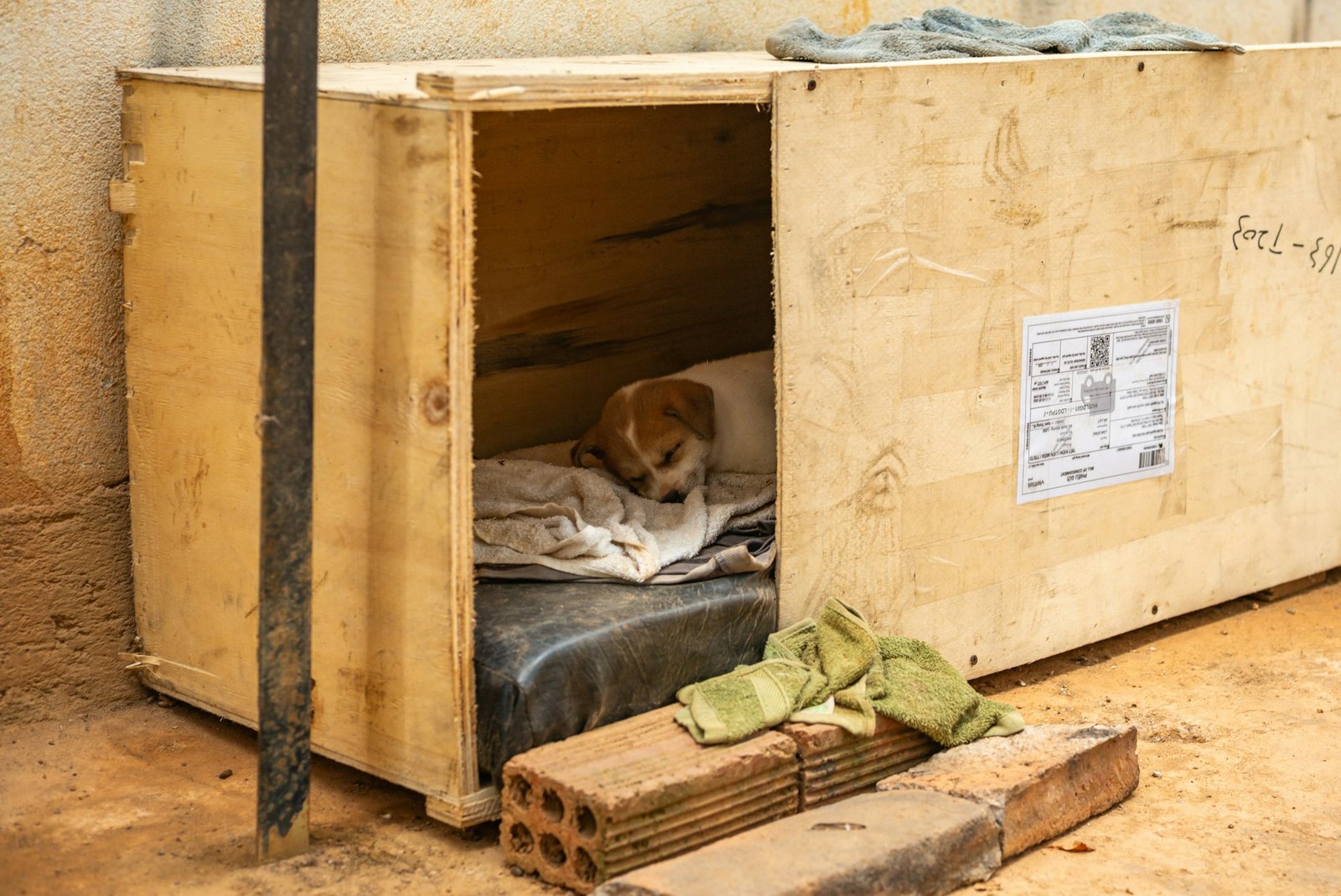
When we brought Figo home, the crate sat in the corner of the kitchen for three days before he’d go near it. My mother-in-law took one look and asked why we were putting the puppy in a cage. Fair question, and one nearly every British dog owner asks at some point — usually out loud, usually to someone who’s just spent £60 on a crate.
Here’s the honest answer we arrived at, and it’s the whole basis of this guide: a crate is only ever as kind as the way you introduce it. Done badly — puppy shoved in, door shut, ignored while he screams — it’s a cage, and your mother-in-law is right. Done properly, it becomes the one place in a noisy house where a puppy can switch off completely, which is worth a great deal when you’ve got children, visitors, a doorbell and a hoover all competing for his nervous system.
This is the method we used, the mistakes we made, and what to do when it goes wrong at three in the morning.
Is crate training cruel?

Not inherently, no — but the question deserves better than a flat reassurance.
Dogs aren’t den animals in the way the old training books claimed; wild canids use dens for whelping, not for everyday sleeping. So the “it’s natural, they love a den” argument is shakier than it’s usually presented. What is true is that dogs seek out enclosed, defensible resting spots when they want to be undisturbed, which is why yours ends up behind the sofa or under the dining table.
A crate works because it formalises that instinct and gives it a location you’ve chosen. The crate isn’t doing the work — the association is. A puppy who has learned that the crate means chews, quiet and nobody bothering him will take himself into it voluntarily by week three. That’s the actual measure of success, and it’s the one to judge yourself against.
Where crate training genuinely is the wrong call: if you’re planning to use it to contain a dog for long working days, if your puppy is already showing real panic when confined, or if you’re reaching for it as a solution to separation anxiety in an adult dog. That last one matters — shutting an anxious dog in a small space usually makes the anxiety worse, not better. If that’s your situation, start with our guide to separation anxiety instead — the crate isn’t your starting point.
Choosing the crate
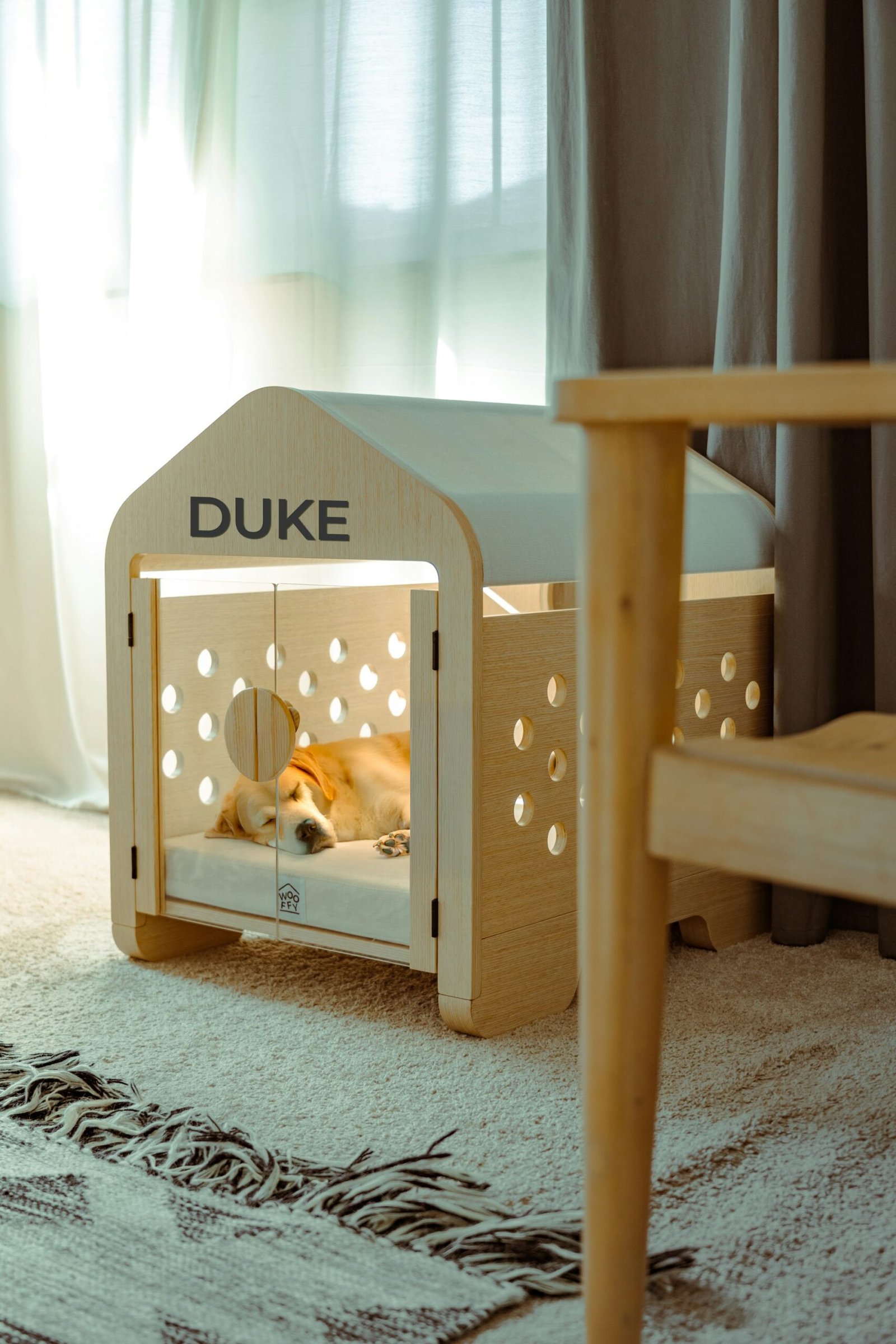
Size is the thing people get wrong, in both directions.
Your puppy should be able to stand without ducking, turn round comfortably, and lie fully stretched out on his side. That’s the minimum. But a crate that’s much bigger than that undermines toilet training, because a puppy who can’t reach a corner far enough from his bed will hold on, and one who can will simply use it.
The practical answer for a growing puppy is to buy the crate he’ll need as an adult and use the divider panel that comes with most of them, moving it back every few weeks. For a cocker like Figo that meant a 30-inch crate divided down to about half for the first two months. A Labrador or similar will want 42 inches eventually; a small terrier will be fine at 24.
For the inside: a flat, washable mat rather than a deep plush bed to begin with, because early accidents are likely and you’ll want to strip it at 2am without much ceremony. A blanket over the top and three sides makes a real difference to how quickly most puppies settle — it cuts the visual traffic of a busy room. Leave the front open so it doesn’t feel sealed.
Skip the water bowl clipped to the door overnight for a young puppy; offer water last thing and first thing instead. And nothing with a collar attached inside the crate — collars and crate bars are a genuinely bad combination when nobody’s watching.
Where to put it
Ground floor, in the room the family actually uses, away from the radiator and out of direct sun. Not the utility room, not the hallway, not anywhere he’ll be alone by default.
For the first week or two of nights, though, put it in your bedroom. This single decision saves more sleep than anything else in this guide, and it’s the one most people resist because they don’t want to “make a rod for their own back.” You’re not. You’re letting an eight-week-old puppy who has just lost his mother and every littermate he’s ever known hear another breathing creature at night. You can move the crate out by degrees later — a metre a night towards the door works well — once he’s sleeping through.
The two-week plan
Nothing here should be rushed, and if a stage goes badly you drop back to the previous one rather than pushing through. The timings below are what worked for us; a confident puppy might halve them and a wary one might double them.
Days 1–2: the crate is furniture. Door open or removed entirely. Feed every meal just inside the doorway, then a little further in as he gets bolder. Drop treats in when he isn’t looking, so he finds them himself. Say nothing, make no fuss, don’t lure him in with encouraging noises — you want him to discover it, not perform for you.
Days 3–4: in and out freely. Start putting his chew or a stuffed Kong right at the back. Let him come out whenever he wants. If he takes the chew out and eats it on the floor, that’s fine — leave it, try again next time.
Days 5–6: the door closes. Two seconds, while he’s eating. Open it before he finishes. Build to ten seconds, then thirty, always opening the door before he’s asked. The rule that matters: never open the door while he’s crying, because you’ll teach him precisely what to do. Wait for a two-second pause and open on that instead.
Days 7–9: you leave the room. Door closed, chew in, and you walk out for thirty seconds. Come back in without ceremony — no big greeting, nothing to make your return the exciting part of the day. Build to five minutes, then twenty.
Days 10–14: real absences. Put the kettle on, go to the shop, sit in the garden. Twenty minutes, then forty, then an hour. Keep some of these short and random so that crate-time doesn’t reliably predict a long absence.
Throughout all of this, the crate door should stay open at every other moment of the day. A crate that’s only ever shut is a crate that predicts confinement.
Night-time
Nights are where most people’s resolve breaks, and the crate does a lot of the heavy lifting — but only if you’ve done the daytime stages above first. A crate that’s only ever shut at bedtime is a crate your puppy will fight.
Two rules specific to the crate at night. Keep it in your bedroom for the first week or two, as above. And when he does need to go out for a wee — which at eight weeks he genuinely will, two or three times a night — carry or lead him straight out and straight back in, with as little conversation as possible, so the crate stays a place of quiet rather than a place he cries to escape.
Everything else about those first few nights — what’s normal, how to tell settling-crying from a real request, and how to survive the sleep deprivation — we’ve covered separately in our guide to puppies crying at night. Our toilet training guide covers the daytime routine that makes the nights easier.
Helping a puppy settle

Some puppies flop down in the crate and sleep. Others wind themselves up. A few things that reliably help the second sort:
A proper walk or training session before crate time, but not immediately before — an over-aroused puppy needs twenty minutes to come down first. A long-lasting chew given only in the crate, so it becomes something he goes in for. A ticking clock or low radio, which sounds like an old wives’ tale and works anyway. And a genuinely dull environment: covered crate, lights low, no eye contact.
For the moments you know will be harder than usual — the first night home, fireworks in November, a house full of relatives at Christmas — we’ve used Calmdogs calming treats alongside the routine. They’re a complementary feed rather than anything medical, and they won’t do the training for you; what they’re useful for is taking a bit of the edge off a specific stressful evening while the training does the actual work. If your puppy is distressed rather than just unsettled, that’s a conversation for your vet, not a treat.
How long is too long?
The honest UK guidance, and the one most rescue organisations here work to: a puppy shouldn’t be crated for longer than he can comfortably hold his bladder, and no dog should be crated for extended periods as a routine daytime arrangement.
As a rough working figure, a puppy can manage roughly his age in months plus one, in hours — so a three-month-old is good for about four hours, maximum, and that’s a ceiling rather than a target. Overnight is the exception, because he’s asleep and his system slows down.
If your working day means eight hours alone, a crate isn’t the answer to that problem — a midday visit from a dog walker or sitter is. It’s worth sorting before the puppy arrives rather than after.
When it goes wrong
He screams the moment the door shuts. You’ve moved too fast. Go back two stages, and spend three or four days there rather than one. Sit next to the crate with your hand through the bars if you need to. Nobody gets a prize for finishing in a fortnight.
He’s toileting in the crate. Usually one of three things: the crate is too big, he’s being left longer than he can manage, or he came from a breeder or shop where he had no choice but to soil his sleeping area. The third takes patience and a rock-solid outdoor routine to undo.
He’s shredding the bedding. Take it out for a few weeks and use a bare mat — some puppies simply cannot be trusted with fabric yet. This is usually a chewing stage rather than a crate problem, and our puppy biting guide covers where the rest of that energy should be going.
He’s panicking — drooling, scrabbling at the door, hurting himself. Stop. This isn’t stubbornness and it won’t improve with repetition. Speak to your vet, and consider a puppy class or one-to-one training support. A playpen or a puppy-proofed room is a perfectly respectable alternative, and plenty of very well-adjusted dogs have never seen the inside of a crate.
When do you stop?
Most people stop shutting the door somewhere between nine and eighteen months, once the dog can be trusted not to eat the skirting board. Very few take the crate away entirely, though — Figo’s stayed in the corner of the kitchen with the door tied open for years, and it’s still where he goes when the house gets loud or somebody’s hoovering. If your dog reaches adulthood and still finds busy moments hard going, our guide to calming your dog naturally has more on building that sense of safety beyond the crate itself.
That’s the outcome worth aiming for. Not a dog who tolerates being shut in, but one who takes himself off to a place he chose, because he’s always known nothing bad happens there.
Written by Georgiana, with Figo asleep in his crate as usual. Have a puppy question we haven’t covered? Have a look around Calmshops or drop us a line — we answer everything.