

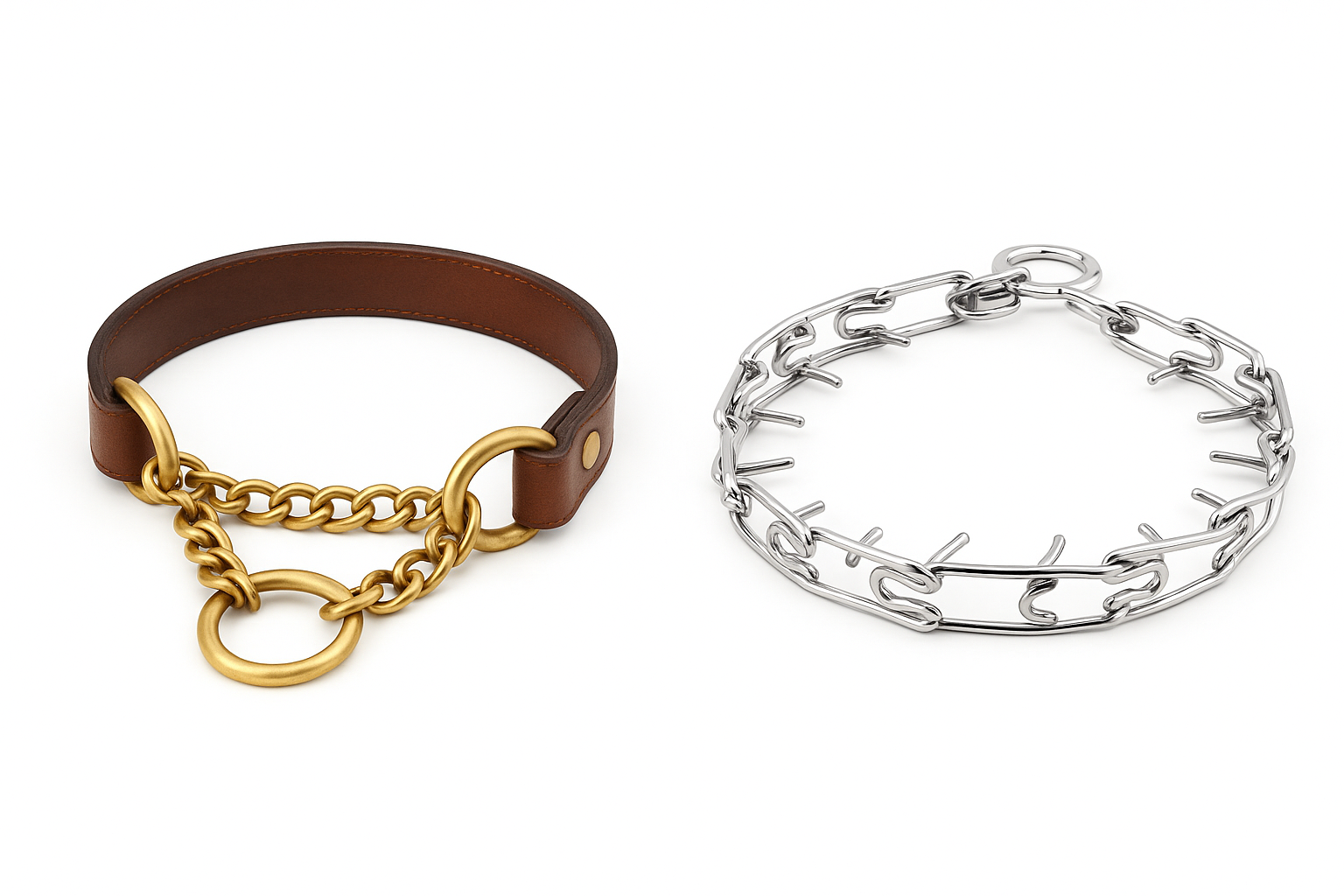
Are prong collars cruel? The UK welfare and veterinary bodies we checked all advise against them: the RSPCA calls them “painful and unethical”, and the vets’ associations class them as aversive. Martingale collars are a different design. They tighten only to a set limit, and their main job is to stop a dog backing out of the collar, not to correct pulling. Below, we explain how each one works, what UK welfare bodies actually say, and what to use for a dog who pulls.
What is a martingale collar and how does it work?
A martingale has two loops. The larger loop goes around your dog’s neck, and the lead clips to a smaller loop. When the lead goes tight, the small loop pulls the large one in, but only so far. When the lead is slack, the collar sits loosely.
Martingales are widely used for sighthounds such as greyhounds, whose necks are wider than their heads, which makes it easier for them to slip out of an ordinary collar. Greyhounds As Pets NSW, an Australian greyhound adoption programme, explains that a martingale should not tighten past the width of the dog’s neck. By contrast, it says, “Choke collars and slip collars are designed to tighten (and keep tightening)” when a dog pulls.
What is a prong collar and how does it work?
A prong collar, also called a pinch collar, is a chain of metal links with prongs facing inwards. The RSPCA describes it plainly: “When a dog pulls on the lead, the metal prongs of the collar close and prong the sensitive skin around the neck.” The RSPCA also says prong collars “are designed to cause pain or discomfort to the animal to reduce or stop them from pulling on their lead.”
So the difference is not just strength. A martingale’s design aim is to stop escape. A prong collar’s design aim is to make pulling uncomfortable.
What do UK welfare bodies say about prong collars?
We read each statement at its source rather than relying on summaries. Here is what they say.
| Organisation | What it says |
|---|---|
| RSPCA | “Prong collars are painful and unethical training collars.” It says the prongs can cause “potential injury and infection from puncture wounds and nerve damage”, and that it wants them banned. |
| BSAVA (small animal vets) | “The BSAVA recommends against the use of aversive methods for training animals”, giving examples “such as electric shock collars, prong collars, spray collars, choke chains and electric containment fences”. It recommends positive reinforcement instead. |
| BVA with BSAVA | Their joint policy position says aversive methods have “the potential to result in negative welfare outcomes eg. choke collars, choke chains and prong collars”, and lists collars using noise, vibration, ultrasound or spray in the same sentence. Both recommend positive training methods. |
| Blue Cross (2014 statement) | “We wouldn’t, under any circumstances, advocate the use of pinch or prong collars to correct an unwanted behaviour.” |
| The Royal Kennel Club | Since 1 January 2018 it has prohibited “pinch collars, electronic shock collars and prong collars” at its licensed agility, obedience, working trials, heelwork to music, rally and canicross events. |
| Dogs Trust | Its loose-lead guide warns against equipment that “causes pain or discomfort when the dog pulls by putting tension in a sensitive area”, and suggests something comfortable “such as a flat harness or collar”. |
Lorella Notari, the RSPCA’s vet clinical head of behaviour, adds that “the repeated pressure of collars like choke and prong collars can cause severe inflammation of the skin and muscle”.
That is a clear and consistent picture. We have not found a UK welfare body that recommends prong collars.
Are martingale collars cruel?
None of the UK pages above mentions martingale collars by name, so we can’t tell you there is an official position either way. What we can say is how the advice we did find applies.
A martingale fitted as designed, on a dog walking on a slack lead, isn’t putting pressure on the neck most of the time. The problems start when it is used like a choke collar: fitted too loose so it closes further than it should, or tightened with lead jerks as a correction. At that point it runs into the same concerns the BSAVA and Dogs Trust raise about tension on the neck.
A Canadian animal shelter’s martingale fitting guide sets out sensible limits:
- Fit it behind the ears, so you can “easily slip 2 fingers under the collar”.
- It “should never be used to purposefully choke, harm or startle your dog”.
- Take it off when you aren’t supervising your dog, as it can catch on things.
- For dogs who pull a lot, it can put “excessive pressure on their neck”, and the guide recommends a harness instead.
In short: a martingale is a tool for keeping a slim-headed dog in their collar. It isn’t a fix for pulling.
Are prong collars legal in the UK?
The RSPCA’s page says “Prong collars aren’t illegal sadly”, and the charity is campaigning for a ban. We haven’t found a UK law that names them.
That doesn’t mean anything goes. In England and Wales, section 4 of the Animal Welfare Act 2006 makes it an offence to cause a protected animal unnecessary suffering where you knew, or ought reasonably to have known, that your act would have that effect. How that applies to any piece of equipment depends on the facts, so we won’t guess at it here.
Does a prong collar cover make a difference?
Fabric or neoprene covers are sold to slip over the metal links. A cover changes how the collar looks and may stop the links rubbing the coat. It doesn’t change how the collar works: it still tightens around the neck when the lead goes tight, which is the part the welfare bodies object to.
What can I use instead for a dog who pulls?
The advice from the RSPCA and Dogs Trust lines up: a comfortable, well-fitted harness, plus food rewards for walking by your side. Dogs Trust’s loose-lead method goes roughly like this:
- Start somewhere quiet, like your home or garden, and reward your dog for being next to you.
- Add a few steps, then more, rewarding them for staying by your side.
- Bring in distractions slowly, and go back a stage if it gets too hard.
- The moment the lead goes tight, stop and wait quietly. Don’t jerk the lead or tell them off. Walk on once it is slack again.
- Be consistent on every walk, and expect walks to take longer while they learn.
If your dog also lunges or barks at other dogs, our guide to dogs who pull and react to other dogs covers distance and rewards in more detail. For a wider look at collars, harnesses and head collars, see how to choose a training collar, and if you are stuck, a reward-based trainer from our dog trainer directory can help.
If the pulling comes with fear, lunging or sudden changes in behaviour, or you think your dog may be in pain, talk to your vet first. They can check for a medical cause and refer you to a qualified behaviourist.
Calmshops, the family-run Oxfordshire shop behind AboutDogs, has a plain-English rundown of 12 types of dog training collar if you want to compare options side by side. While you are teaching loose-lead walking to a strong puller, we’d keep the lead in your hand, attached to a comfortable harness.
Martingale vs prong collar at a glance
| Martingale collar | Prong collar | |
|---|---|---|
| How it works | Small loop tightens the main loop to a set limit | Metal prongs close on the neck when the lead goes tight |
| Main purpose | Stops a dog slipping out of the collar | Makes pulling uncomfortable |
| Who it is meant for | Sighthounds and dogs whose heads are narrower than their necks | Not recommended by any UK welfare body we found |
| UK welfare body view | No UK position found specifically on martingales | RSPCA, BSAVA, BVA and Blue Cross advise against; banned at Royal Kennel Club licensed activity events |
| Fixes pulling? | No. Use a harness and reward-based training | Welfare bodies recommend reward-based training instead |
Frequently asked questions
Are prong collars cruel?
The RSPCA calls prong collars painful and unethical, and the BSAVA and BVA class them as aversive training equipment that can harm welfare. Blue Cross has said it would not advocate them under any circumstances. We have not found a UK welfare body that recommends them, so for a dog who pulls, a well-fitted harness and reward-based training is the route they all point to.
Is a martingale collar the same as a choke chain?
No. A choke or slip collar keeps tightening as long as the lead is pulled. A martingale is designed to tighten only to a set limit, mainly to stop a slim-headed dog backing out of the collar. It can still be misused if it is fitted too loose or jerked as a correction, so fit and use matter.
Are prong collars banned in the UK?
The RSPCA says prong collars are not illegal in the UK and is campaigning for a ban. We have not found a UK law that names them. In England and Wales, the Animal Welfare Act 2006 makes it an offence to cause an animal unnecessary suffering. The Royal Kennel Club has prohibited prong collars at its licensed activity events since 2018.
Will a martingale collar stop my dog pulling?
No. A martingale is meant to keep a dog in the collar, not to teach loose-lead walking. One shelter fitting guide says it can put too much pressure on the neck of a dog who pulls a lot, and recommends a harness instead. Pair a comfortable harness with rewards for walking by your side.
How should a martingale collar fit?
The large loop should slip over your dog’s head and sit behind the ears, with room to slip two fingers underneath. When the lead is tight, it should close to a snug fit without choking. Take it off when your dog is unsupervised, as it can catch on things, and check the brand’s sizing chart before you buy.